
A Simple Way I've Integrated Writing in My Middle School Social Studies Classes

Last year I started utilizing notebooks like the one pictured here in my U.S. History and Geography and World Cultures classes. The impetus behind the change was largely due to my observation that my students needed to WRITE more. There were other factors that played a role, albeit a lesser role, for example, students struggling to submit digital assignments in Google Classroom.

I use "Historian's Notebooks," "Geography Journals," "Citizenship Notebooks," etc. most frequently with stations activities/centers. I've also used notebooks with primary source analysis activities, map skills practice, and other work.


These "notebooks" have been such a success in my middle school classroom, that I have increased the frequency of their use.

Creating these notebooks takes a little time but once you get the hang of it, it gets easier and less time-consuming. I've created my notebooks using both PowerPoint and Google Slides. (Tip: Make sure everything on your second slide is upside down!) Once you've created your notebook, simply print your copies back-to-back and fold in half! Easy peasy. 

This is my Middle Ages Notebook. Look at slide #2 Do you see how everything on the second slide is upside down. This is important because when you print your notebooks back-to-back, you want everything orientated correctly. 


For lessons taking more than one class period, I store the notebooks in my classroom (each period has a separate wire basket) and I hand them out at the beginning of each class period. No more lost assignments!

Interested in a copy of my Montgomery Bus Boycott Historian's Notebook? Click here for a copy!


I've also noticed a marked improvement in student writing. Students are more engaged with the material as well. (Less passive typing and more writing, highlighting, sketch noting, etc.) ✏️


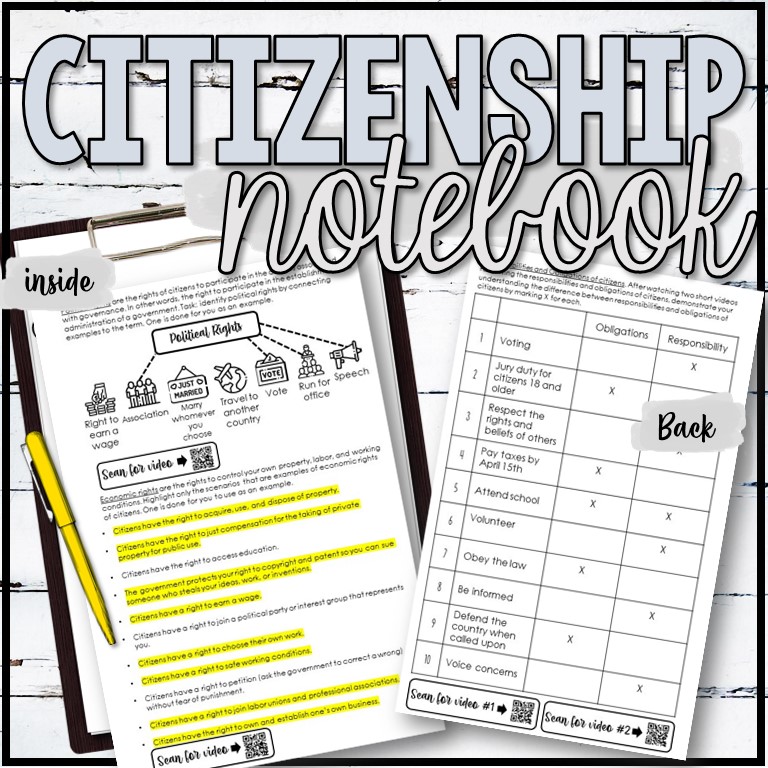
Next year I will be teaching 8th-grade Civics in addition to my World Geography class. (No more U.S. History 😢). I haven't taught Civics for several years (more like 5 years!) I'm in the process of updating my old Civics lessons. The resource pictured here is a two-day lesson focusing on the following topics: What is the definition of a citizen? What is a good citizen? What are personal, political, and economic rights? What's the difference between civic responsibilities and civic obligations?

If you're looking for a lesson covering these topics and you'd like to save yourself some time, check out my Civic Rights and Responsibilities lesson just posted in my TpT store. I've got you covered. 


Interested in my Geographer's Notebook on the War in Ukraine? Click here for a previous blog post on the subject. 


Comments

Popular posts from this blog

10 Creative One-Pager Ideas for Social Studies

10 Creative One-Pager Ideas for Social Studies As a social studies teacher, you understand that the subject is one of the most important aspects of education, and it is vital to keep your students engaged and motivated in their learning. One way to achieve this is through the use of one-pagers, a creative and visually appealing way to summarize information and showcase understanding. One-pagers offer a chance to showcase a student’s creativity, critical thinking skills, and grasp of the subject. In this blog post, we will explore ten creative one-pager ideas for social studies that will not only maximize your students’ learning but also spark their creativity and critical thinking skills. Why Use One-Pagers in Social Studies? One-pagers are an excellent way to get students engaged in the learning process. They are a creative and visually appealing way to summarize information and showcase understanding. By utilizing one-pagers, you can help your students to: Process information more ef...

Examples of Map Legends and Map Symbols (Plus Creative Tips and Project Ideas!)

Creative tips and projects for teaching students about legends (keys) on a map: 1. Create a scavenger hunt: Give students a map with a key and have them find different landmarks or features on the map. For example, you might ask them to find a park, a school, and a river. This is a fun way to get students engaged with maps and help them learn how to read legends. 2. Make your own map: Have students create their own maps of their school or neighborhood. They can include symbols for different features like buildings, parks, and roads. This is a great way to get students thinking about the different elements that go into making a map. 3. Use technology: There are many online tools that allow you to create custom maps with your own symbols and legends. Have students use these tools to create their own maps of their community or a fictional place. 4. Create a legend matching game: Create cards with different symbols from a map legend and have students match them to the correct definition. T...

Ripped Paper World Map Project - Middle or High School Geography

Earlier this week I presented my students with a challenge. Create a world map using construction paper, glue, and a sharpie. No scissors.  Students were not allowed to use any tools to cut out their continents. They had to tear their continents from construction paper. After their continents were ready, students were asked to label them and then glue them in place.  Each student's map needed a title, compass rose, key, symbols, Equator, and Prime Meridian, and all the continents and oceans had to be labeled. Most of my students had a blast creating their maps. Of course, a couple students were anxious; worried their continents wouldn't look nice. With some reassuring, they proceeded and did just fine.  This activity is a perfect back-to-school or sub-day activity. It required very little prep and materials. I let my students use any color construction paper they wanted as long as they selected two different colors.  The results were fantastic! Grab your copy of the ...